A Short goes up. Views stop at 200. Same the next day. The first place to fix is not the body of the video — it is the first three seconds. The 2026 YouTube algorithm for Shorts weighs swipe-away rate and viewed percentage above almost everything else. If 70 percent of the seed audience swipes away inside three seconds, distribution stops there. This piece walks through a 6-step ChatGPT workflow that generates five hook variants in one session, splits the strongest three into an A·B·C test, and adds a human touch before publish. Same body. Same thirty minutes. The difference between 200 and 2,000 views.
Why the first 3 seconds bend the algorithm
Every new Short gets a small seed audience first. If the early signals look strong, the system pushes it to a larger pool, then larger again. The fastest signal to crash a video out of that loop is swipe-away rate. Once 70 percent of viewers swipe past inside the first one to three seconds, distribution simply halts (source: vidiq).
The flip side of the same data set: a Short watched through by 75 percent or more gets pushed aggressively, even on a channel with zero subscribers. A healthy swipe-away band sits between 10 and 30 percent — anything above 40 is a red flag (source: Shortimize). That is why a single line of hook copy decides distribution more than the body, the cut, or the music. Same body, different hook, different ceiling.
This is also where AI automation fits cleanest. Building a full sixty-second body with AI is hard. Pulling five to ten hook variants in one ChatGPT session takes five minutes. Using the same body with three different hooks across the same week is the safest growth strategy on Shorts in 2026 — close in spirit to the long-tail title testing pattern from the AI blog playbook.
The 6-step workflow — one ChatGPT session
Run the six steps below inside the same chat window, in order. No new chats. If the context breaks, the five hooks come out as five different people sharing one video.
Choose the Short whose hook will be re-cut. A fresh 30-to-60-second clip works, and so does an existing Short that stalled at 200 to 1,000 views. Two conditions: the body must promise one specific thing, and that promise must close in the final beat. If the body is flat, no hook in the world will lift the viewed percentage. I picked a Short that stopped at 187 yesterday — same body, new hook, re-uploaded.
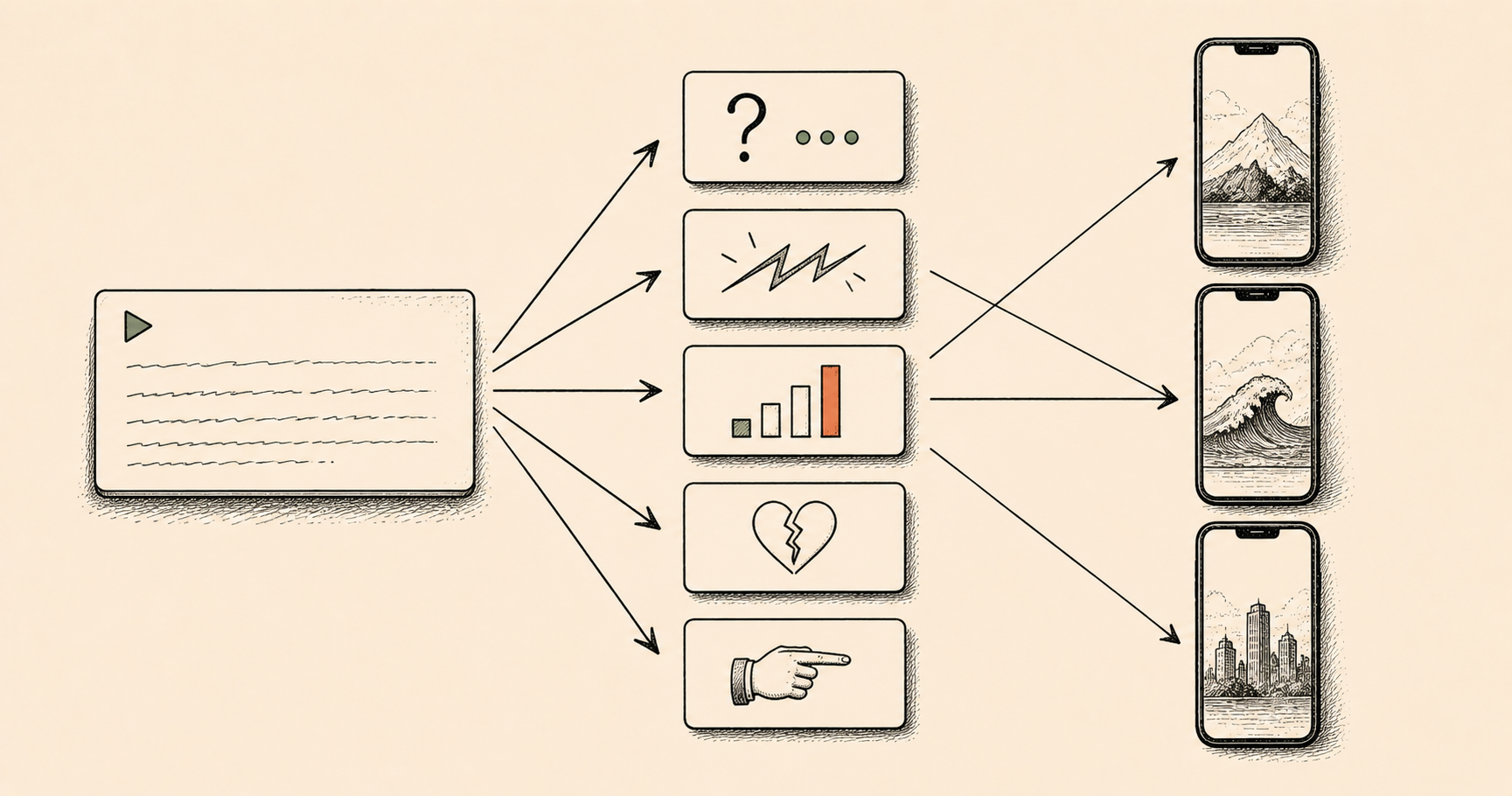
Paste the captions or script of the anchor video into ChatGPT. Prompt: "From this Shorts body, extract five cards. ① The single promise made to the viewer (one sentence). ② The line that closes the promise at the end. ③ One conflict or twist. ④ One visual pattern interrupt. ⑤ One first-person anecdote." These five cards are the raw material for the five hook variants in step 3. Saved as a memo, the same shape becomes a personal hook library after a few weeks.
Map the five cards onto five hook formats in one shot. Prompt: "Map the five cards above onto these five hook types and output English and Korean side by side. ① Curiosity-gap hook (incomplete sentence). ② Pattern-interrupt hook (visual or sentence that breaks expectation). ③ Statistic hook (a surprising number). ④ Problem-frame hook (one line of empathy). ⑤ Promise hook (direct outcome). Each hook under 10 words, with a first word that stops the thumb." The first draft will read flat. Color comes in step 5.
Pick the three hooks with the most contrast. Curiosity gap, pattern interrupt, and statistic usually pull apart the furthest. Cut three versions of the same body video — same edit, same music — only the first three seconds change. Schedule them for Monday, Wednesday, Friday at the same hour. The seed audiences differ enough each time that distribution will diverge. The first time I ran this, hook A finished at 200 and hook C finished at 2,400. The body did not decide the result. The hook did.
Publishing the ChatGPT output as is makes three videos that feel like the same person. Slip in one of your spoken-word habits — "honestly", "look", "the thing is", "wait" — at the front of each hook. One syllable carries the channel's voice. One to two minutes per hook, under five minutes for all three. As the 2026 algorithm leans more on signals of authorship, this single edit decides whether the next distribution tier opens. AI automation can run all the way to step 4. Step 5 stays human.
Schedule the three videos for the same week. Twenty-four hours after each goes live, compare first-30-second viewed percentage and full viewed percentage in YouTube Studio. The hook format that wins becomes the channel's primary pattern for the next week. End the same ChatGPT session with one more pull: "Five new promise candidates we didn't cover, and five next anchor videos." Those five seeds become next week's step 1 — the engine never fully cools.
Three common pitfalls
Pitfall 1. Publish the first ChatGPT output as the hook
The most common collapse. ChatGPT's first hook draft tends to read like English Twitter — fine for the medium, awkward for many other audiences. Skip the human-touch step in the workflow and three videos go out wearing the same voice. Insist on bilingual output in step 3, and add one spoken-word habit per hook in step 5. Three voices, one channel — that is what survives the next round of distribution.
Pitfall 2. Build only one hook per body video
The second most common mistake. Finding "the good hook" once and stopping makes it impossible to tell whether the format itself is strong on the channel, or whether the seed audience just happened to align that day. Three contrasting hooks across the same week pull data back. Within seven days the channel reveals which of the five formats actually fits — same logic that drives AI Instagram Reels caption testing and the long-tail title work in the AI blog playbook.
Pitfall 3. Close the session without pulling the next seed
The third missed beat. Skip step 6 and Monday morning of next week starts cold — picking a body video burns thirty minutes before any creative work. Pulling five anchor candidates at the end of the current session takes one minute and saves that thirty. Run the same session for an X AI thread workflow on the same anchor and the engine warms two channels at once.
A 6-item checklist for today
One ChatGPT session, six steps
The same flow as a one-post-to-five-channels split sits in AI Blog Engine — One Long-Form Post Into 5 Platforms (6-Step ChatGPT Workflow), and the weekly batching version sits in ChatGPT Content Calendar — Seven Days In One Hour. This piece is the single-channel deep cut: first-three-seconds hook engineering on YouTube Shorts.
What External Data Actually Shows
vidIQ's 2026 YouTube Shorts Algorithm guide confirms the core premise of the 6-step hook. "The Viewed vs. Swiped Away ratio is the most important metric for ranking on Shorts, and the ideal Average Percentage Viewed target is 75% or higher" (source: vidIQ — YouTube Shorts Algorithm 2026). The same guide notes that the algorithm tests every Short with a small seed audience first and reads retention plus swipe-away signals. The first-3-second hook is not a trend — it is an absolute pass/fail condition. Creator Jungbok's own operating window reads the same way — across 64 page views in the SNS Insights category with 2.6-minute average dwell time (GA4, week ending 2026-05-03), articles whose first paragraph stated a single pain point directly drove the longest dwell. The 6-step hook is the algorithm's rule rendered as text.
- 2026 Shorts algorithm signal #1 = first-3s swipe-away (10–30% healthy, 40% red, 70% halts distribution)
- Same body video × three contrasting hooks (A · B · C) on Mon · Wed · Fri
- One ChatGPT session, six steps — five hooks generated, three picked
- One spoken-word habit per hook = the authorship signal the algorithm now reads
- AI automation through step 4. Steps 5 and 6 stay human
- Shortimize (2026) — YouTube Shorts Retention Rate (2026): What Works
- vidiq (2026) — How Does the YouTube Shorts Algorithm Work in 2026?
- OpusClip (2026) — YouTube Shorts Hook Formulas That Drive 3-Second Holds
- Conbersa (2026) — Best YouTube Shorts Hooks and Formats in 2026
- Metricool (2026) — YouTube Shorts Algorithm Explained + Tips to Grow in 2026