On April 22, 2026, OpenAI rolled out ChatGPT Workspace Agents in research preview (sources: OpenAI blog; VentureBeat). The release is a class of semi-autonomous agents that connect natively to Slack, Google Workspace and Salesforce, designed to run repeatable workflows without a human in the middle. The feature is free until May 6, 2026 in ChatGPT Business, Enterprise, Edu and Teachers, then shifts to credit-based pricing (source: OpenAI). For creators using ChatGPT to power an AI blog, the launch matters for one reason — it points at where the standard for "what comes after Custom GPTs" is heading.
What Workspace Agents Actually Ship With
Cross-referencing the OpenAI announcement with VentureBeat and UC Today, the launch lands on four mechanics — connectors, scheduled runs, shared deployment, and a no-code builder (sources: OpenAI, April 22, 2026; VentureBeat). Coverage frames this as the successor to Custom GPTs and the first time team-deployable agents have been productized at this scale inside ChatGPT.
Direct integrations to Slack, Google Workspace (Gmail, Drive, Calendar, Docs, Sheets) and Salesforce. Agents read and write across those apps from inside ChatGPT, no third-party orchestrator needed.
Agents can be set to run on a schedule. A morning trend digest, a weekly content recap, or a daily blog brief all execute without a separate cron stack.
Deploy an agent into a Slack workspace and it picks up requests as they arrive. For solo operators, even a one-person Slack becomes a command line for the agent.
Pre-built templates plus a conversational builder. Multi-step workflows can be defined without code, lowering the entry cost of AI blog and newsletter automation.
Why It Matters Now — The Post-Custom-GPT Standard
VentureBeat called the release "a successor to Custom GPTs for enterprises" (source: VentureBeat, April 22, 2026). UC Today flagged that five major vendors — OpenAI, Microsoft Copilot Studio, Anthropic Claude Managed Agents, Google Gemini Enterprise and Salesforce Agentforce — pushed enterprise agent products in the same week. Agents as the next SaaS surface is no longer a forecast; it is the working assumption.
Two things follow for creators. First, AI automation moves a notch deeper into ChatGPT itself. For light pipelines, the n8n / Zapier layer is no longer required to wire Slack, Google Docs and Sheets together. Second, the operating heuristic gets product-level endorsement: if a task happens twice or more daily, it is a candidate for an agent.
The AI Blog + Multi-Platform Workflow
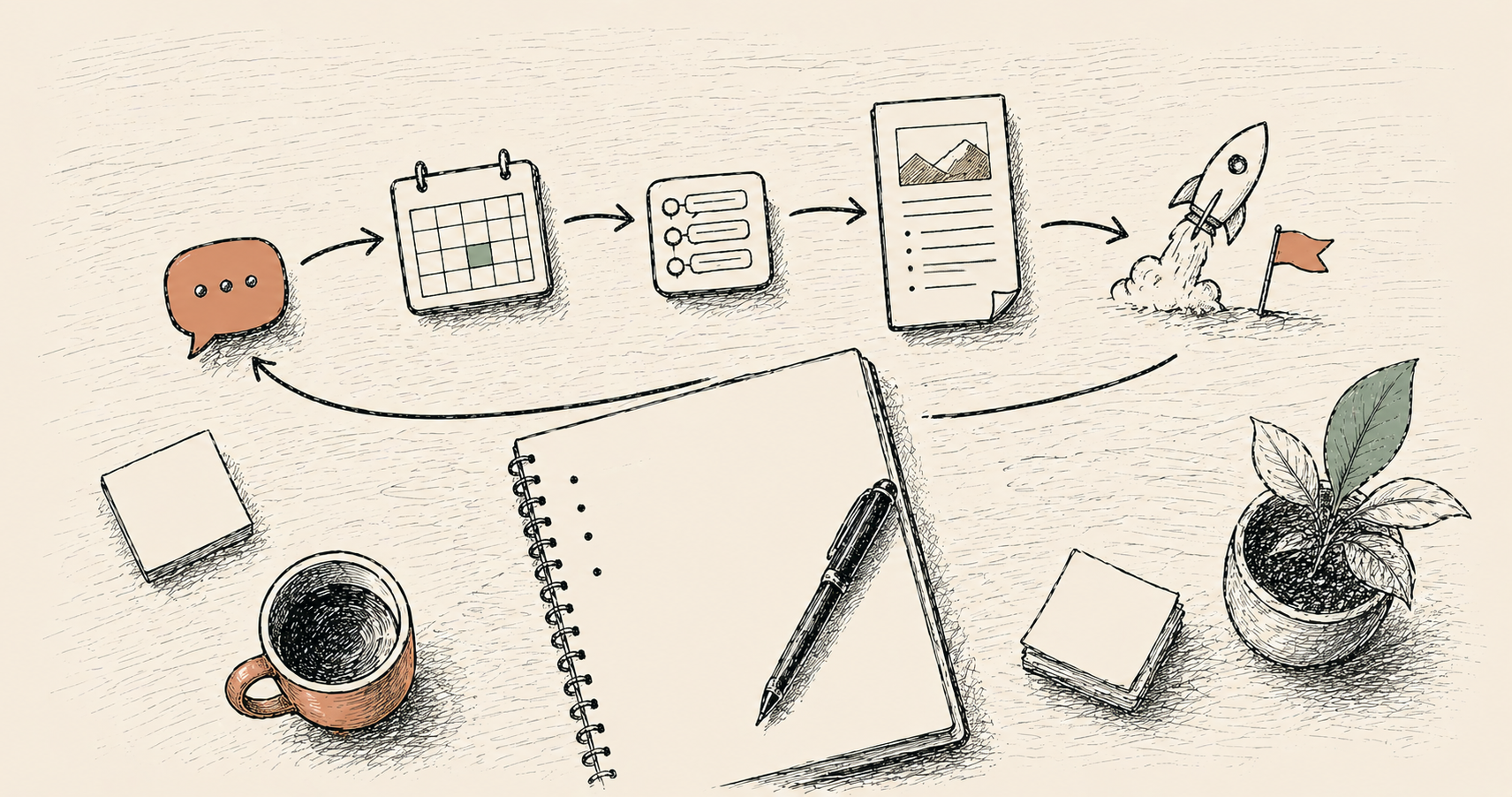
The substance of the change shows when AI automation reaches into the content pipeline itself. Trend research → draft → multi-platform distribution can collapse inside a single ChatGPT workspace, removing the copy-paste seams between tools.
→ Five tools, the human is the bridge
→ Two tools, the human only judges
The shift hits AI blog operations first. Daily category-based trend gathering, post-publication compression into SNS cards, and link harvesting are repeatable by definition. The recent multi-step reasoning bump is the engine behind the reliability of these agent-run loops.
Cross-platform distribution follows the same shape. The X AI assistant + Slack trigger + Google Sheets log layout can fold into a single Workspace Agent. The agent then outputs the AI Instagram caption, the AI TikTok hook draft and the Shorts memo from one shared brief — three platforms, one input. The weekly-cadence application of the same direction is in the ChatGPT Content Calendar 7-step playbook.
Three Moves to Make Now
1. Write down one workflow. Pick one task that runs twice or more daily, and put input → process → output on a single page. The person who can describe the task in writing becomes the first useful operator of AI automation.
2. Use the free window before May 6, 2026. Workspace Agents is open at no charge inside ChatGPT Business, Enterprise, Edu and Teachers until that date (source: OpenAI). Even a solo creator can build one end-to-end agent during the window — that single round-trip is the fastest learning path.
3. Keep a one-week failure log. Note where the agent stalled, where the output drifted. After seven days the boundary becomes visible: which tasks deserve a human, and which can move to the agent. The Practice section's "publish what works and what doesn't, as fact" stance maps directly onto agent ops.
What OpenAI's Official Data Actually Shows
OpenAI's own announcement confirms every premise of the workflow above. "Workspace agents are in research preview on ChatGPT Business, Enterprise, Edu, and Teachers plans, free until May 6, 2026, and shift to credit-based pricing on that date" (source: OpenAI — Introducing Workspace Agents). Control is explicitly handed to the user — "you decide what tools and data the agent can use, what actions it can take, and when approval is required." AgentKit ships separately, bundling "an Agent Builder visual canvas, Connector Registry and ChatKit" (source: OpenAI — Introducing AgentKit). Creator Jungbok's own operating window reads as follows — across 142 page views in the AI×creator trends category in our first month (GA4, week ending 2026-05-03), articles in the automation/workflow cluster pulled the average dwell time up most consistently. The free window through 2026-05-06 is the entry door for a solo creator — the fastest learning path is to build one single agent end-to-end inside that window.
- April 22, 2026 — OpenAI shipped ChatGPT Workspace Agents in research preview.
- Mechanics: direct Slack / Google Workspace / Salesforce connectors, scheduled runs, no-code builder.
- Move: pick one twice-daily task, build a single agent, log seven days before expanding.
- Caveat: credit pricing begins May 6, 2026 — model the per-run cost first.
- OpenAI — Introducing workspace agents in ChatGPT (April 22, 2026)
- VentureBeat — OpenAI unveils Workspace Agents, a successor to Custom GPTs
- UC Today — OpenAI Workspace Agents Launch in ChatGPT
- OpenAI Academy — Workspace agents