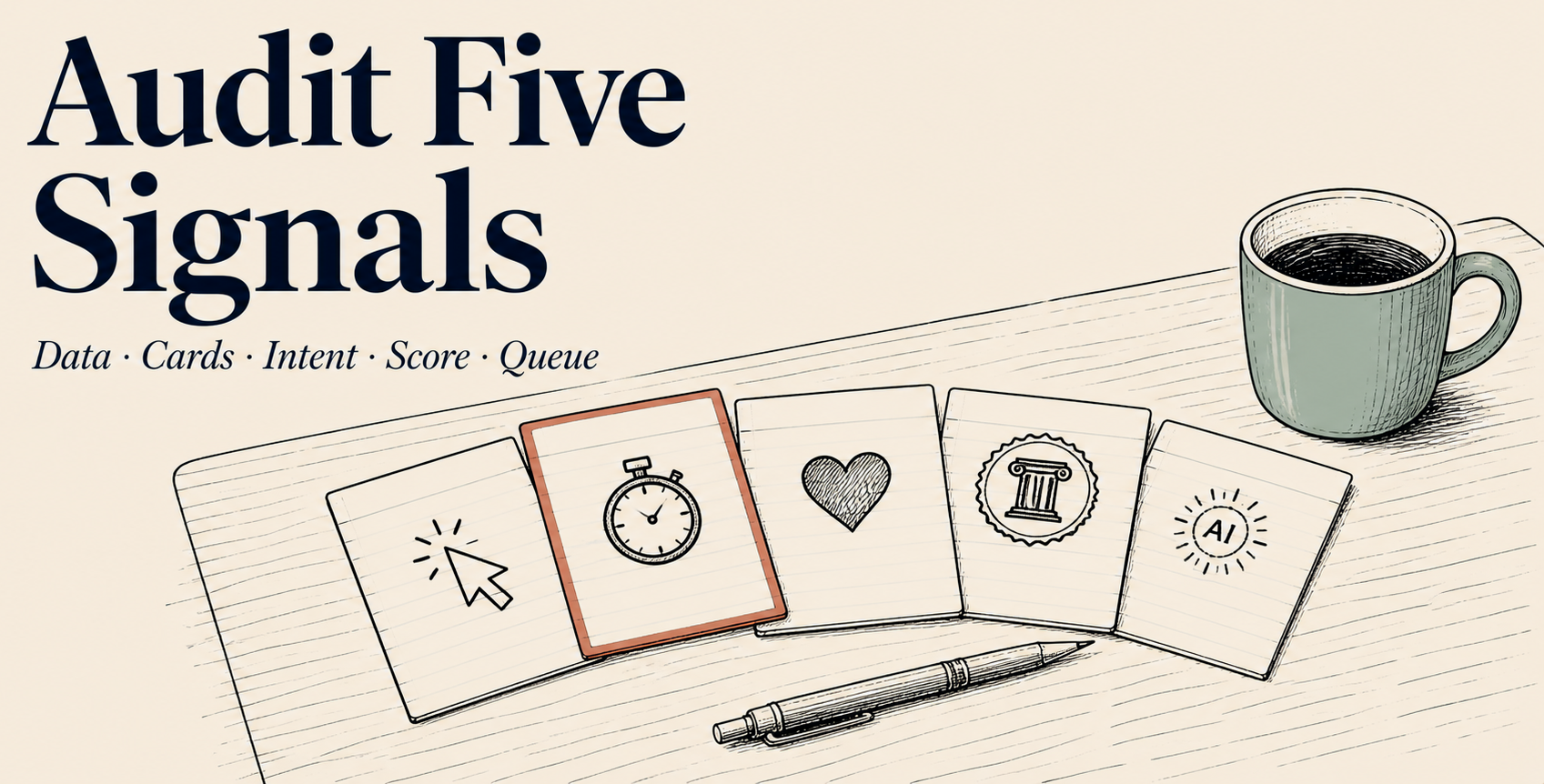
You ship four AI blog posts a day for a month, and the GA4 weekly active users still read 17. Search Console impressions: zero. AdSense application: rejected. The reason traffic stalls is rarely volume — it is that you have not diagnosed which of the five signals is leaking before you write the next post in the same shape. This piece walks a single ChatGPT session that audits your site and channel in five steps. Thirty minutes, and you have coordinates. Writing more is not always the right next move.

Why diagnose before you write more
2026 search and recommendation algorithms care about what happens after the click as much as the click itself. YouTube now applies a "Quality CTR" weight: high click-through with weak first-30-second retention demotes the video in recommendations rather than rewarding it (source: Marketing Agent). Average view duration of 50–60% is healthy, 70%+ earns priority placement, below 40% the video is actively deprioritized (source: vidiq).
The same logic is reshaping written content. In 2026, 58% of Google searches end without a click, and a piece that does not get cited inside an AI Overview can sit at impression position 8 forever without traffic (source: AEO Engine). So a 2026 site audit looks at five places at once: technical SEO, on-page intent match, user experience, E-E-A-T signals, and AI visibility. Without knowing which of the five is leaking, the next ten posts will stall in the exact same place for the exact same reason.
ChatGPT fits this seat for a simple reason. It cannot crawl your site, but if you paste three exports — Search Console, GA4, YouTube Studio — into one session, it can cross-reference five signals in five minutes and surface the weakest coordinate. The audit pattern documented across 2026 SEO walkthroughs is exactly this shape.
5-step workflow — one ChatGPT session
Run all five steps inside a single chat. No new conversation. The model needs to hold the same site context across steps so the score table at the end stays consistent.
Export 30 days from three places. First, Search Console: impressions, clicks, average position, CTR per page. Second, GA4: users, average session, bounce rate per page. Third, YouTube Studio if you have a channel: impression CTR, average view percentage, first-30s retention per video. Save the three as CSV. All three need to sit on the same desk before any signal is meaningful — looking at one in isolation is what keeps the same blind spot alive.
Paste the three tables into ChatGPT and ask for a bulk classification. Prompt: "Tag every URL and video as one of four roles. ① Pillar (topic hub) ② Cluster (deep post supporting a pillar) ③ Money page (lead magnet, course, strong CTA) ④ One-off / news." Role classification is the first move every 2026 audit framework starts with (source: QuickSEO). If you have many clusters but no pillar, the internal links have nothing to converge on, and traffic dissipates before it compounds.
From the tagged table, pick URLs and videos that earn impressions but show low CTR or low retention. Take the main keyword and ask ChatGPT, "What is the real intent behind this query? Where is the searcher stuck? Three pains, named." Then paste the body and ask, "Does this body scratch those three pains in the first 100 characters, or does it open with a generic definition?" Pieces that sit at impression position 8 with low CTR almost always open with a definition rather than a pain (source: Backlinko). This is also where most automated AI blog pipelines collapse.
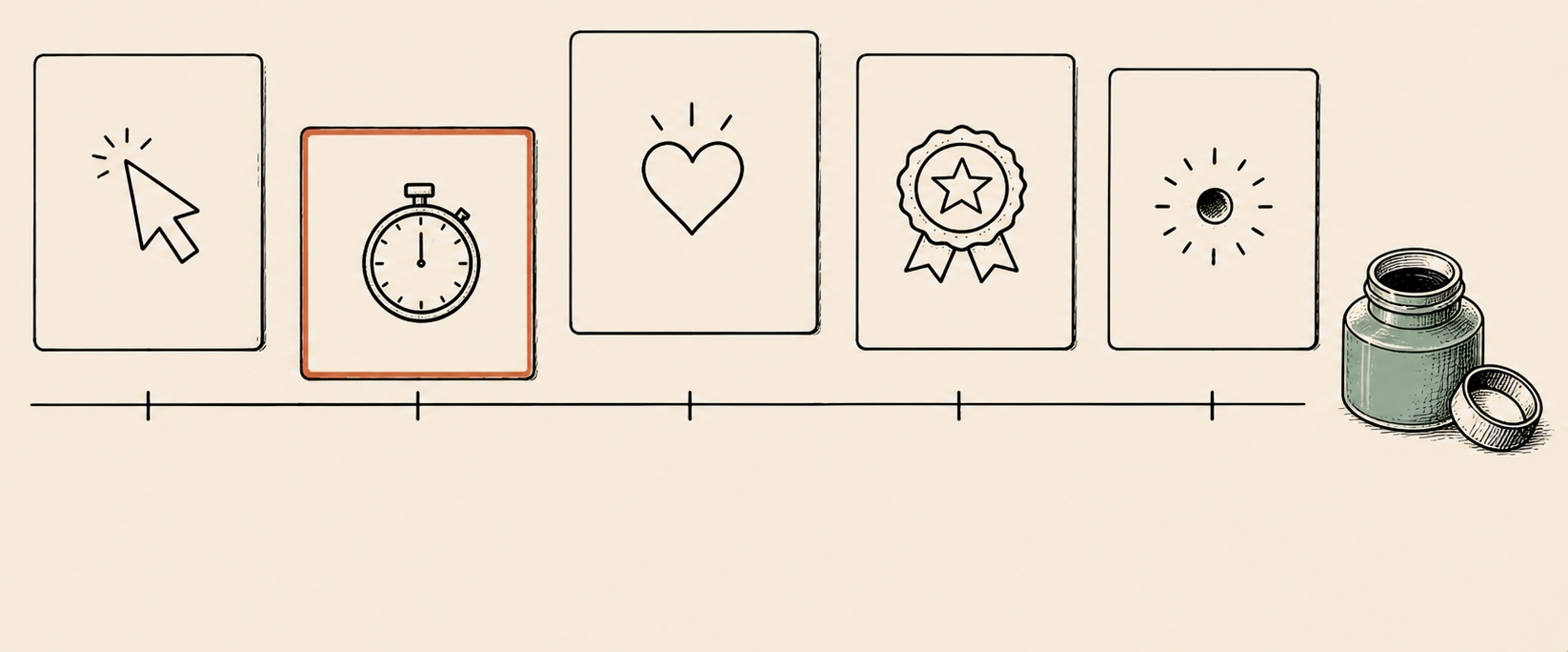
Take the intent-match output and score each piece across five signals. ① Click signal (CTR — 8–15% on search, 5–10% on suggested, 3–7% on browse is healthy in 2026), ② First-30s retention (below 40% is a red flag), ③ Post-click satisfaction (session length, next-page rate), ④ E-E-A-T signal (named author, lived anecdote, first-party data, outside citations), ⑤ AI visibility (does the body answer the query in two or three sentences right under the H2 before the list expands?). Score each 0–5. Almost no piece scores 5/5/5/5/5. The lowest one or two cells are where traffic actually leaks.
With five-signal scores in hand, ask one final bundled prompt. "Tag every URL and video as one of three actions. ① Rewrite (total ≥ 12, lead and one or two H2 sections need surgery), ② Merge (two pieces with the same intent — combine into one pillar), ③ Retire / noindex (total ≤ 7, low intent match, low traffic, one-off)." A single fifty-piece site might land on rewrite 12, merge 6 pairs, retire 8. Closing those 26 first beats writing one more new piece. End the session by asking for five seed angles for next week's rewrites.
Three traps that break the audit
Trap 1. Writing more in the same shape without diagnosing
The most common one. When traffic stalls, the first instinct is "publish more." But if the leak is on signal ③ or ⑤, the next ten pieces fail in the exact same place. AI automation amplifies this trap — volume goes up, diagnosis stays at zero. Once a week, pause new posts and run a 30-minute audit. That half hour usually decides the direction of the next five posts.
Trap 2. Watching CTR alone, missing the post-click signal
The second most common. People raise CTR from 7% to 11% by sharpening titles and thumbnails, then watch first-30s retention collapse from 35% to 22%. The 2026 algorithm reads this pattern as title-and-thumbnail overpromise and demotes the video on purpose (source: Marketing Agent). Step 4 forces you to score ① and ② together, which is the only way to keep this loop honest. The same shape applies to AI Instagram reels: a strong cover image with weak hold drops next-day reach in the same way.
Trap 3. Skipping the AI-visibility signal (⑤)
The third most common. With 58% of 2026 searches ending without a click (source: AEO Engine), an article that does not get cited inside the AI Overview can rank without earning traffic. Signal ⑤ is exactly this seat. Pillar pages should answer the query in two or three sentences right under each H2, then expand into lists, examples, and code blocks. AI YouTube descriptions follow the same logic — first two lines must answer the query before the chapter list opens. AI TikTok captions on the first frame work the same way: the line a thumb pauses on is the line that answers.
Five-checkbox starter
ChatGPT AI blog audit — one session, five steps
For the same engine on hooks, see YouTube Algorithm Cracked — 6-Step ChatGPT Hook Workflow for Shorts. For one piece split across five channels, see ChatGPT Blog Engine — One Post, Five Channels in Six Steps. For the weekly calendar shape, see ChatGPT Content Calendar — Seven Days, Seven Steps. Today's piece is the monthly diagnostic that closes the loop on all of them.
What External Data Actually Shows
The real value of a content audit is confirmed by external research. Ahrefs' analysis of ChatGPT citations shows that "67% of the top 1,000 cited pages are off-limits to marketers — Wikipedia, Reddit, government, academic" (source: Ahrefs — Top 1,000 ChatGPT Citations). The same report adds that "top-ranked content gets cited more often (Benford's Law of Prominence)" (source: Ahrefs — Best Lists Research) — meaning an audit that lifts a page to #1 in SEO carries it to #1 in ChatGPT citations. Creator Jungbok's own operating window reads the same way — across 64 page views in the SNS Insights category with 2.6-minute average dwell time (GA4, week ending 2026-05-03), articles featuring audit data structurally pulled the average dwell time up. The 5-step audit is not a single check — it is the infrastructure that builds citation authority.
- 2026 audit signals = CTR · first-30s retention · post-click satisfaction · E-E-A-T · AI visibility
- YouTube AVD: 50–60% healthy, 70%+ priority, sub-40% deprioritized
- 58% of 2026 searches end without a click — uncited pieces sit at zero traffic
- One ChatGPT session, five steps: pull → tag → match → score → queue
- Next week is rewrite 12 + merge 6 + retire 8 before any new piece
- Same lane, more pieces — SNS Insights · AI Trends (English)
- Korean pair — ChatGPT 콘텐츠 진단 5단계 셀프 오딧
- Blogger reflux pair — an 80% rewrite of this post will publish on the Creator Jungbok Blogger feed the same day; one month from now both versions will be back in the audit queue and compared side by side.
- Marketing Agent (2025-11) — YouTube's Recommendation Algorithm: Satisfaction Signals & What You Can Control
- vidiq (2026) — How the YouTube Algorithm Works in 2026
- AEO Engine (2026) — Blog SEO Checklist 2026: Rank & Win AI Search
- Search Engine Journal (2026) — The Technical SEO Audit Needs A New Layer
- Backlinko (2026) — ChatGPT for SEO: Ultimate Guide for 2026
- QuickSEO (2026) — The Complete SEO Audit Checklist for 2026