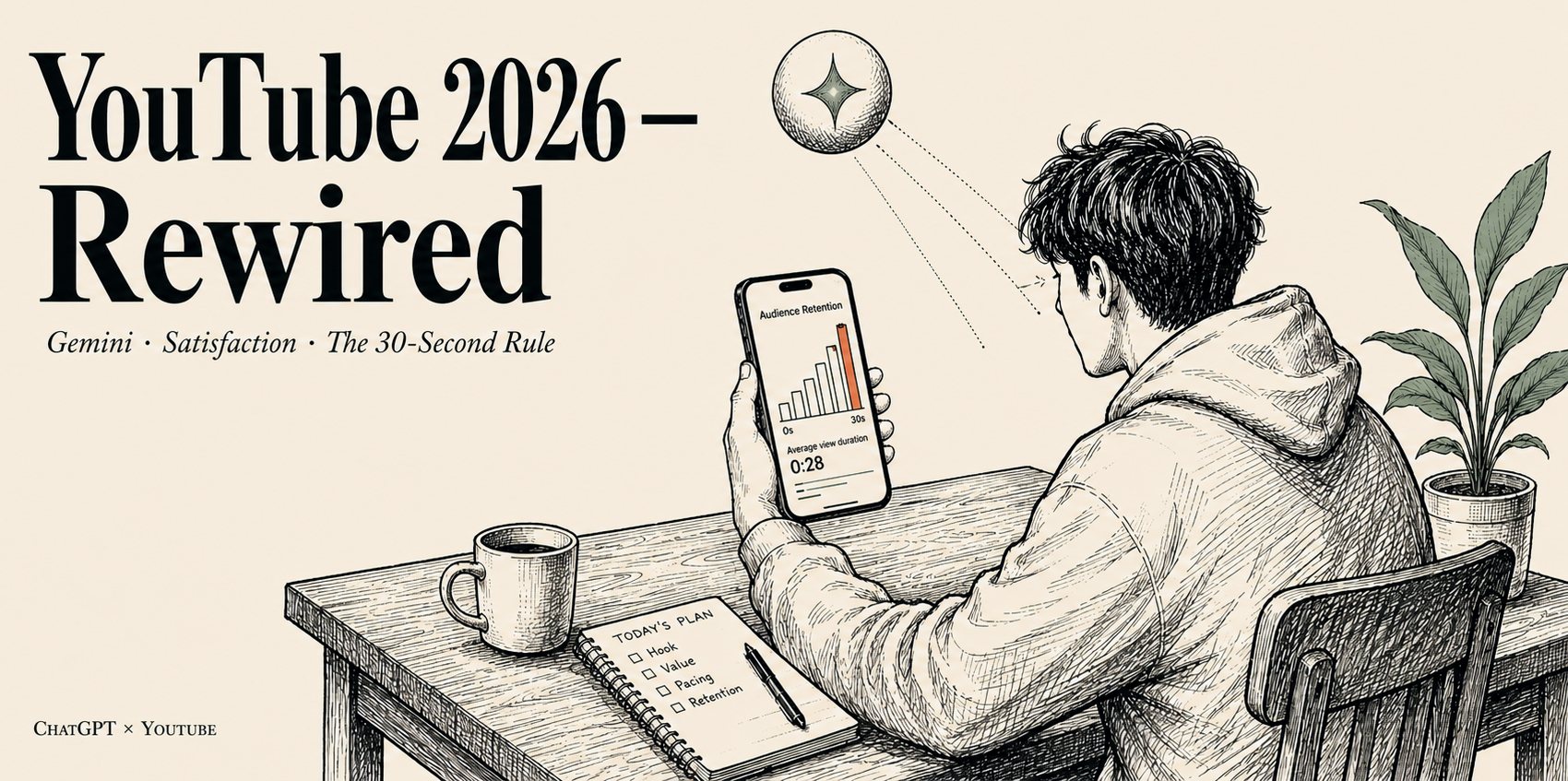

As of May 1, 2026, the YouTube algorithm works very differently from the watch-time machine creators got used to (sources: vidiq, masculinesynergy). After the January 2026 Gemini integration, the model reads videos frame by frame, parses on-screen text and pacing, and weighs post-watch satisfaction surveys as a live signal (source: PostEverywhere). At the same time, the Hype button is now globally rolled out across 39 countries, opening a 7-day boost slot for channels with 500 to 500,000 subscribers (sources: TechCrunch, YouTube Blog). For solo operators running an AI YouTube channel, ChatGPT is now the fastest way to redesign hooks, captions and CTAs around these signals — and an AI automation pipeline that ignores them gets penalised within days.
What changed — the four signals Gemini reads
When Google rewired the recommendation engine onto Gemini in January 2026, ranking moved from a single watch-time score to a multi-layer signal stack evaluated together (source: masculinesynergy, 2026-04). Four of those signals now drive most of a video's reach.
Gemini scores visual change rate, on-screen text, pacing and emotion. Cut frequency and speech density in the first 30 seconds feed straight into ranking (source: vidiq).
Post-watch "was this video worth your time?" surveys now sit above watch time in the ranking stack (source: PostEverywhere). Roughly 70% positive replies is the viral threshold.
If first-30-second retention is under 70% in the test window, distribution stalls (sources: PostEverywhere, dataslayer). CTR under 4% also throttles reach.
Comments full of complaint or argument now cost reach, even when engagement is high (source: masculinesynergy). Rage-bait strategies are effectively over.
Hype button goes global — a new ramp for small channels
The other half of the story is the Hype button. Globally launched on August 26, 2025 and live in 39 countries, Hype lets fans push new long-form videos into a 7-day leaderboard, with multipliers that favour channels between 500 and 500,000 subscribers (sources: TechCrunch, YouTube Blog). For solo creators, that means external traffic from X AI threads or an AI Instagram push during the first 7 days now buys real ranking lift.
The AI automation angle is direct. ChatGPT Workspace Agents can already produce hooks, captions and an AI blog companion piece in one pass — the new step is staging all of that to land inside the 7-day Hype window with a single launch day.

How to rebuild the rules with ChatGPT — a 4-step workflow
Solo operators do not need theory; they need a procedure. The cleanest way to keep ChatGPT useful under the new algorithm is to lock these four steps into every new video.
Title and thumbnail first
Single watch-time score
Visual cuts, on-screen text and emotion designed together
Multi-layer satisfaction + session score
Step 1: 30-second hook script via ChatGPT. Feed the topic and the conclusion, and ask for a script that states the conclusion once and triggers four visual changes inside 30 seconds. Have ChatGPT return a small table of speech density and cut count so the hook is auditable.
Step 2: Design on-screen captions separately. Gemini reads captions as a distinct signal, so the words on screen should add information that the spoken track does not repeat. Reels Teleprompter caption extracts are a clean source to feed back into ChatGPT for repurposing.
Step 3: Add a one-line satisfaction prompt. Replace generic "did this help?" lines with a verb-first ask such as "reply with the one thing you are taking away from this". ChatGPT can produce five A/B variants from the video's conclusion in a single prompt.
Step 4: Standardise the next-video handoff. Session time is now part of the ranking stack, so the last 5 seconds of every upload should send viewers to the same channel's next video. Even when an AI blog, Reels or Shorts version exists, the long-form ending stays inside YouTube.
Three things to apply this week
1. Lock a 30-second hook template. Conclusion in one line, promise in one line, one visual preview cut. Save it as a system prompt in ChatGPT so every new video starts from the same spine. Reels and Shorts inherit the same rule.
2. Build a 7-day Hype runway on external channels. On launch day, share the long-form link from X AI threads, an AI Instagram caption stack and a newsletter blast. Hype multiplies smaller channels harder, so the external traffic must arrive inside the 7-day window.
3. Operationalise satisfaction comments. Add a fixed "one-line takeaway" closer to every video, then have ChatGPT cluster those replies weekly to seed next week's topics. Plug that loop into the existing ChatGPT Workspace Agents pipeline so the rule evolves with data, not guesses.
What External Algorithm Data Actually Shows
vidIQ's 2026 YouTube Algorithm guide confirms the core premise of the 4-step workflow above directly. "The latest YouTube algorithm prioritizes satisfaction over raw watch time" — satisfaction is measured by repeat viewing, "Not Interested" clicks, and whether viewers continue to the next video after yours (source: vidIQ — How the YouTube Algorithm Works in 2026). The same guide notes that "relevance comes first, then satisfaction; small channels can outrank big channels in search precisely on this satisfaction signal." It also documents that "short videos with high retention can outrank longer videos where viewers drop off" (source: same). Creator Jungbok's own operating window reads the same way — across 142 page views in the AI×creator trends category in our first month (GA4, week ending 2026-05-03), articles with low first-30s drop-off were the ones that successfully chained readers into the next piece in the cluster. The 4-step workflow above (Gemini reads on-screen captions as a separate signal → ChatGPT rebuilds the hook, captions, satisfaction line and next-video handoff) is precisely the spot where satisfaction signal gets manufactured.
- Since January 2026 YouTube ranks on a multi-signal stack with satisfaction on top
- Floors to clear: 70% retention at 30s, 4%+ CTR, positive comment ratio
- Workflow: ChatGPT for hook, captions, satisfaction line and next-video handoff
- Distribution: stack X AI and AI Instagram traffic inside the 7-day Hype window
- TechCrunch — YouTube's 'Hype' feature that boosts smaller creators launches globally
- YouTube Blog — Hype: Giving fans a stake in boosting their favorite emerging creators
- vidiq — How the YouTube Algorithm Works in 2026: Updates & Tips
- OutlierKit — YouTube Algorithm Updates 2026: Every Change Creators Need to Know
- masculinesynergy — The YouTube Algorithm Update: 2026 Gemini Update Guide